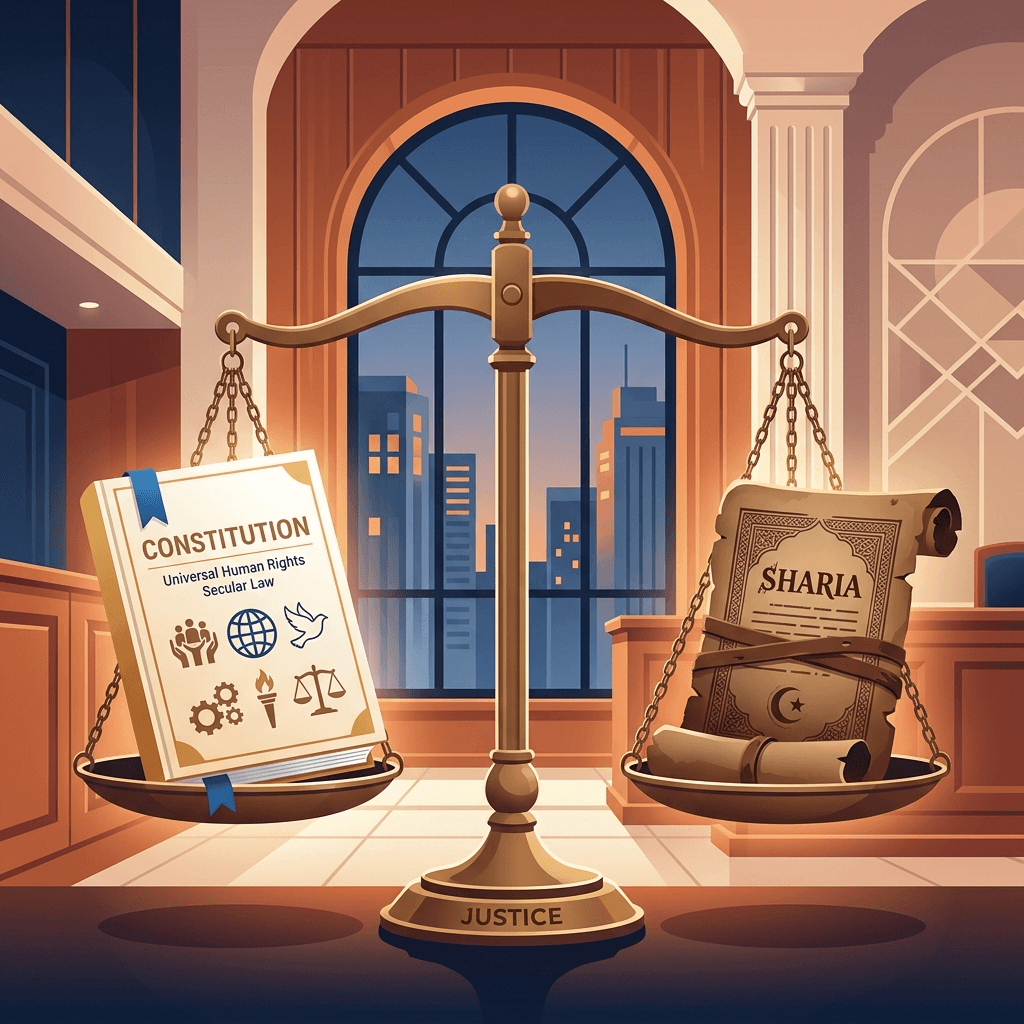
Secular Law vs. Sharia: Rebuilding Iran's Legal Code
The Collapse of Divine Jurisprudence
For more than four decades, the Iranian legal system was bound by the rigid, medieval constructs of Sharia law. Laws were not crafted to protect individual liberties or foster social harmony; instead, they were designed to enforce religious compliance and preserve the absolute power of the clerical class. With the fall of the theocracy, Iran stands at a historic crossroads. The collapse of divine jurisprudence has opened the door for a complete reconstruction of our legal code. To build a just and prosperous society, we must replace Sharia with secular law—a system based on reason, empathy, and the Universal Declaration of Human Rights. This article examines the fundamental differences between these two legal systems and outlines the path toward a modern, secular constitution for Iran.
Under theocratic rule, the law was treated as an immutable set of divine decrees that could not be questioned or modified by human consensus. This created a profound contradiction in a modern world where social values, ethics, and scientific understanding are constantly evolving. Sharia law, rooted in 7th-century tribal norms, could not address the complexities of a 21st-century society. The resulting legal friction was resolved through state violence and oppression. By transition to a secular legal framework, we acknowledge that laws are human-made instruments designed to serve human well-being. Consequently, they must be subject to debate, revision, and democratic consensus. Secular law is dynamic, self-correcting, and centered on human dignity, whereas Sharia is static, dogmatic, and centered on divine obedience.
The Inequality Inherent in Sharia
One of the most devastating aspects of Sharia law is its institutionalized inequality. Sharia explicitly divides citizens into hierarchies based on gender and religious belief. Women are legally treated as half of a man in matters of inheritance, blood money (Diya), and courtroom testimony. In family law, men are granted unilateral rights to polygamy, temporary marriage (Sigheh), and unconditional divorce, while women are trapped in legal dependency. Similarly, non-Muslims and non-believers are relegated to second-class citizenship or, in the case of apostates, sentenced to death. This structural discrimination is not an aberration of the Iranian regime; it is the logical execution of orthodox Islamic jurisprudence.
A secular legal system, by contrast, is built on the principle of absolute equality before the law. A secular constitution does not recognize a citizen's religion, gender, ethnicity, or sexual orientation as a basis for legal privilege or discrimination. In a secular Iran, every individual possesses the same fundamental rights and duties. The abolition of Sharia means that family law will be governed by a civil code that guarantees equal rights in marriage, divorce, and child custody. It means that the state will no longer police the private lives, sexual choices, or personal beliefs of its citizens. Equality is not a concession to be granted by clerics; it is an inherent human right that the secular state is obligated to protect.
Dismantling the Penal Code of Retribution
The Islamic Penal Code of Iran, heavily derived from Sharia, is notorious for its cruelty and lack of rehabilitation. Punishments like stoning, amputation of limbs, blinding, and public executions are designed to terrify the population rather than prevent crime or rehabilitate offenders. The legal concept of Qisas (retribution or eye-for-an-eye) privatizes justice, turning criminal punishment into a cycle of personal vengeance. Furthermore, the criminalization of non-violent acts—such as drinking alcohol, consensual sexual relationships, blasphemy, and apostasy—has filled prisons with political prisoners and ordinary citizens whose only 'crime' was expressing their humanity.
A secular penal code must be drafted on the principles of restorative and rehabilitative justice. Corporal punishment and the death penalty must be permanently abolished. Criminal law must only address actions that cause tangible harm to others, rather than actions that offend religious sensibilities. The code must guarantee the rights of the accused, including the presumption of innocence, the right to legal counsel, and protection against torture and forced confessions. Rebuilding the penal code is not just about changing the laws; it is about humanizing the justice system. We must transition from a regime of vengeance to a system of justice.
The Transition: Drafting a Secular Constitution
Replacing Sharia with secular law is a monumental task that requires a structured, democratic process. The first step is the creation of an independent constituent assembly, elected by the people, to draft a new secular constitution. This document must explicitly separate religion from the state, declare the supremacy of universal human rights, and establish a clear separation of powers among the executive, legislative, and judicial branches of government. The judiciary must be completely independent of religious oversight, and the requirement for judges to be Islamic jurists must be abolished.
Furthermore, we must conduct a comprehensive review of all existing legislation to strip out religious references and discriminatory clauses. This process will require the collaboration of legal scholars, human rights defenders, and civil society organizations. It is not enough to simply change the text of the law; we must also reform the legal culture. Judges, lawyers, and law enforcement officers must be trained in secular jurisprudence and human rights standards. The goal is to build a legal system that inspires trust, protects the weak, and serves as the bedrock of a free, democratic Iran.
Secular Law as the Guardian of Harmony
Critics of secularism often claim that removing religion from the legal system will lead to moral decay and social chaos. However, global evidence shows the exact opposite. Secular societies are consistently more peaceful, prosperous, and just than theocracies. Secular law does not suppress religion; rather, it protects it by ensuring that no single religion can use the power of the state to oppress others. In a secular Iran, religious individuals will be free to practice their faith in private, while non-believers, secularists, and religious minorities will finally be free from religious coercion.
Secular law is the only framework that can accommodate the rich diversity of the Iranian nation. By establishing a neutral public square and a fair legal code, we create a society where cooperation is based on shared citizenship rather than shared faith. The legal transformation of Iran is a declaration of our maturity as a people. We are choosing to govern ourselves through reason and compassion, leaving the medieval chains of Sharia behind. The future of Iranian justice is secular, and it begins with the courage to rebuild.